Marketplace vs. E-commerce: Indian Consumer Buying Behavior
India is currently undergoing a tectonic shift in consumption, both in urban and rural areas.
With over 25 years of experience supporting the domestic and global marketing efforts of numerous well-known companies, eLife supports its Japanese partners in taking the first steps toward expansion in India by carefully picking up the perspectives of local consumers to ensure that they take the first steps in their exploration.
In this column, four people who are well versed in India will share their perspectives on the latest developments and insights from the country. We will provide you with a variety of perspectives on India, which is in the midst of change.
▶ View author profiles
Introduction
Hello, my name is Geetha Anand, and I am a member of the Indian Digital Marketing Association (IAMA).
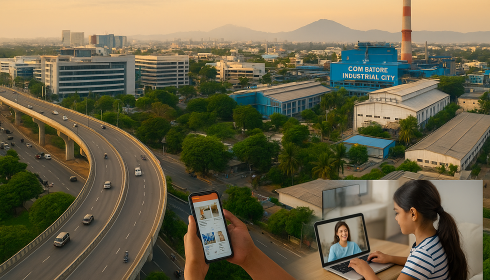
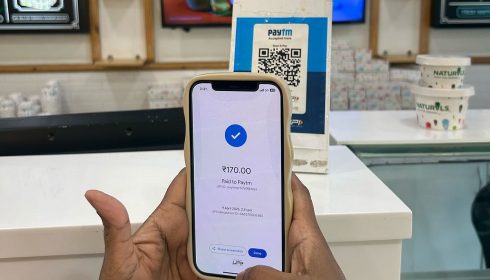
India is rapidly growing into one of the world's leading digital markets, fueled by affordable smartphones and cheap internet communications. In urban areas, everyone has a mobile device and is familiar with using apps, digital payments, and online shopping on a daily basis. In particular, UPI (Unified Payment Interface) has made payments faster and safer and has deeply penetrated society as a whole. In this respect, urban India is a cashless society, several steps ahead of Japan.
Two models and two approaches
Marketplace applications are like giant online marketplaces, where numerous independent vendors list their products and offer them to customers nationwide. These platforms act as a bridge between multiple sellers and buyers, offering a wide range of products and services. Vendors register products, set prices, and manage inventory themselves, while the platforms provide the digital infrastructure, payment processing, and in some cases, logistics support. Leading examples include Amazon, Flipkart, Meesho, and Jio Mart, which have been successful due to their wide selection, competitive pricing, and easy scalability.
E-commerce sites, on the other hand, are usually operated by a single brand or company, which has full control over everything from product registration, pricing, packaging, inventory, logistics, and customer service. The emphasis is on maintaining a consistent brand experience, rather than handling multiple brands. Typical examples are Zudio, Pepperfry, Nykaa, and Wow Skin Science.
Which one you choose depends largely on your company's strategic goals. Marketplaces have the advantage of being able to start selling quickly in a competitive marketplace with little initial investment.
Language Diversity and Localization Strategies
India is a multilingual nation with 22 official languages [*1]. While this is a great opportunity for e-commerce, it is also a challenge: Amazon and Flipkart have invested in regional language support to create a more inclusive digital economy. Amazon, for example, supports Marathi, Bengali, Hindi, English, Kannada, Malayalam, Tamil, and Telugu [*2]. This allows shoppers in regional cities and rural areas to use the site without language barriers.
Similarly, Flipkart has made its app available in 11 regional languages, showing its connection to diverse communities [*3].
According to Meesho's "Smart Shopper" report, the use of local languages has increased by 162%, and voice search has increased by 40%[*4], reinforcing the demand for local languages and ease of use. 4], indicating a growing demand for local languages and ease of use. More than 80% of online buyers in India are already from regional cities [*5].
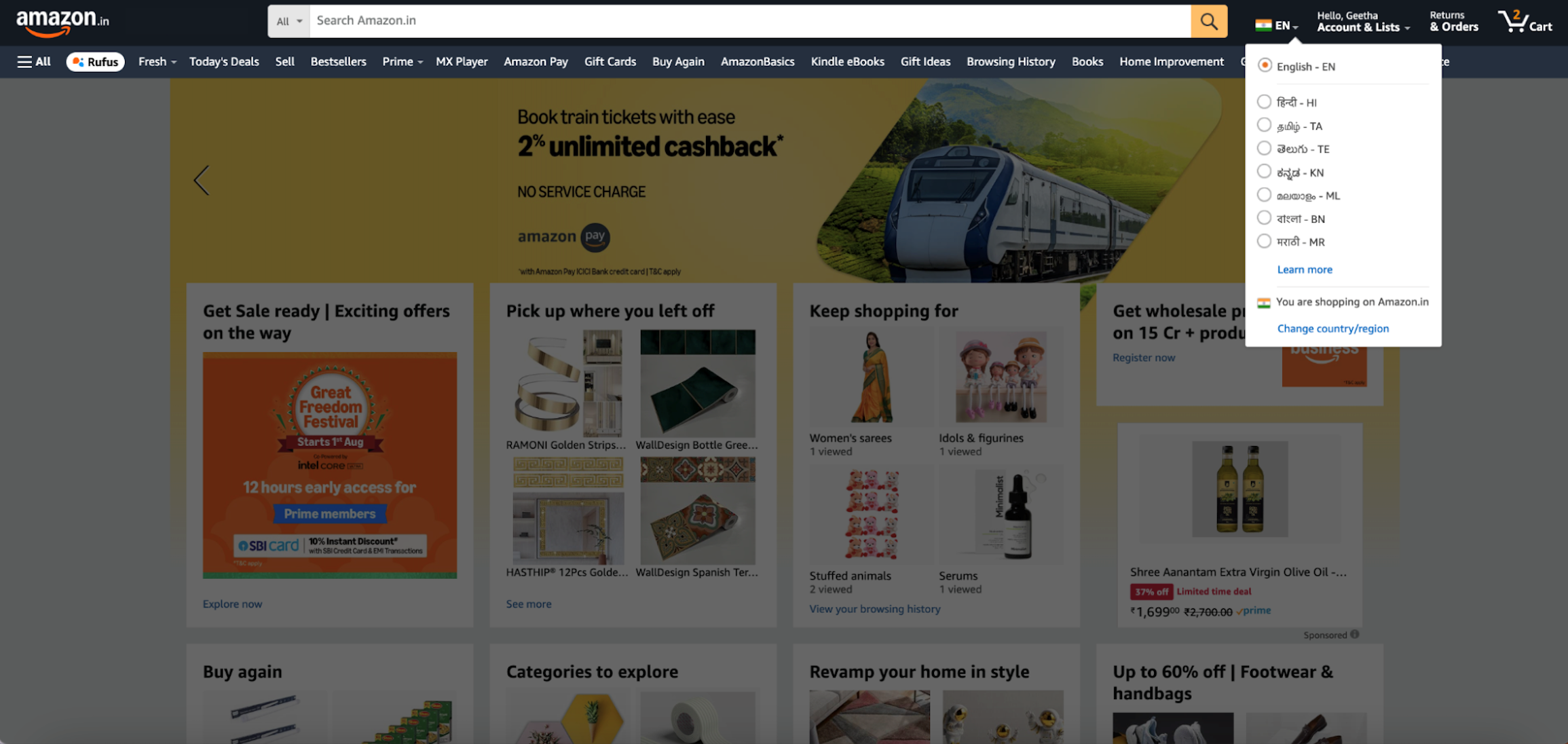
Languages available in Amazon India
What and Where Consumers Buy: Price Focused vs. Trust Focused
Today's shoppers are extremely knowledgeable, confident and more selective. In many cases, value, trust, and convenience are the most important factors.
Those looking for competitive prices prefer marketplace applications. The appeal of the site is that it offers a diverse selection of price points for a single product, from unknown to well-known brands, and limited-time sales and discounts are offered regularly. It is widely used for purchasing household goods, interior design, lighting, and more.
However, because of product defects and more problems associated with delivery, consumers are more cautious about expensive gadgets and personal gifts, and many choose to purchase from trusted e-commerce sites. On-time delivery, safe packaging, and customer support in case of problems provide peace of mind.
Price comparison sites and sale information are important in Japan as well, but in India the polarization between "cheap" and "trustworthy" is even clearer, and consumers are thoroughly aware of the difference in use.
Purchasing behavior concentrated during the festival season
Indian festivals are not only cultural celebrations, but also a time of surge in marketplace and e-commerce sales. Many businesses record sales increases of 30-50% or more during this period [*6]. In Deepavali, Onam, and Pongal, gifts, household goods, and decorative items sell particularly well, and special discounts boost consumption. This is similar to the year-end and New Year's sales in Japan and the Obon shopping season, but is unique in India in that there is a strong link between religious events and purchasing behavior.
For example, during the festive seasons of Deepavali, Onam, and Pongal, millions of people go online to purchase home decorations, gifts, and festive essentials. During these times, a number of special discounts and exclusive promotions are offered to further drive people to buy.
*Diwali / Deepavali.
Around October to November (on the new moon day of the month of Kartika in the Hindu calendar). It is the biggest shopping season of the year, when sales of home appliances, decorative items, clothing, etc. soar.
*Onam.
Around August-September (harvest festival in Kerala, Malayalam month of Chingam). Harvest festival celebrated mainly in Kerala, South India. It is the biggest shopping season of the year in Kerala, as demand for clothing, household goods, and food increases.
*Pongal.
Mid-January (4 days to coincide with "Makara Sankranti" when the sun moves north on the ecliptic). A harvest festival celebrated mainly in the state of Tamil Nadu, South India. Demand for clothing and household goods increases, especially in rural areas, and sales are also held in urban areas.
Real voices of consumers
Vennila, Financial Specialist in Chennai
'I use the Marketplace app for supplies and small purchases. I use the Marketplace app because the prices are competitive, there are lots of great deals and I can find new items that fit my budget. I do most of my regular shopping there.
However, when it comes to expensive items, it's a different story. I check prices and product variations on multiple marketplace apps first, and then make my purchases on trusted e-commerce sites. I feel more comfortable connecting directly with a brand."
Arun Muthuswamy, IT specialist in Bangalore
I use marketplace apps more often than e-commerce sites. The reason is that there is a wide variety of products and you can check the seller's profile. I can compare reviews and ratings, and compare prices and features side by side. An even bigger draw is the frequent discounts and promotions. In most cases, we find that we can buy cheaper than on e-commerce sites. I buy in bulk, especially during the festival season, and save big."
Sales Opportunities for Small Businesses
For many emerging sellers, such as home-based entrepreneurs, artisans, and small retailers, marketplaces such as Meesho, Flipkart Seller Hub, and Amazon Marketplace are a very useful first step to selling online. These platforms are easy to get into, require very little initial investment, and provide a safe environment to try selling products.
Many sellers begin by listing a small number of items and making improvements as they observe the response from their customers. They adjust prices, improve product descriptions, offer discounts, etc. Through trial and error, they find a selling method that works for them.
The marketplace takes care of the operational burdens of packaging, logistics, and customer service, allowing sellers to focus on developing and improving their own products, rather than having to spend time on these menial tasks. Sellers can focus on developing and improving their own products without having to set up their own websites or engage in extensive and complex marketing activities. This makes marketplaces a highly efficient and accessible entry point for anyone who wants to start selling online.
Product development tailored to local culture
India is several steps ahead of Japan in the diffusion of digital payments, if only in urban areas. For example, instant money transfer systems such as UPI are widespread, and QR code payments and mobile wallets are essential to daily life. In Japan, credit cards and cash are still widely used, and the cashless society is limited despite government promotion. In this respect, India's urban areas can be considered a "cashless society one step ahead" of Japan.
On the other hand, however, if one looks at rural and semi-urban areas, there remains a deep-seated trust in cash. E-commerce operators need to adjust to local tastes and cultures, rather than simply applying the urban model to the entire country. E-commerce operators need to adjust to local tastes and cultures. For example, product development and UI design should reflect the festivals and traditions of each region to make customers feel that the service is for them.
Strong cash-on-delivery demand in rural and semi-urban areas
While urban India is more cashless than Japan and UPI and QR code payments are commonplace, in rural and semi-urban areas "trust in cash" remains strong and COD (cash on delivery) is still the norm. The ability to pay after actually seeing the product gives peace of mind to those who are apprehensive about digital payments, and encourages purchasing.
While "cash orientation" is homogeneously spread throughout Japan, a dual structure exists in India: urban = world-leading cashless and rural = cash-centric.
In the growth phase, in-house e-commerce enhances brand strength
As brands enter a growth phase, e-commerce platforms are often a better fit. While marketplaces can be a good way to lower the barrier to entry and pilot market entry, for more mature brands - especially those with premium products or those that produce their own goods - there are significant advantages to having their own e-commerce. have a significant advantage in having their own e-commerce presence.
Running your own brand website allows you to interact directly with customers, making it easier to build trust. It also eliminates the need for commissions paid to marketplaces, thereby increasing profit margins, and gives the brand complete control over its own brand image and customer experience. This is similar to the trend in the Japanese e-commerce market of "moving away from dependence on malls and shifting to own-brand sites," but the difference is that in India, urban consumers tend to be more proactive in using brand-owned sites.
Therefore, companies that are conscious of building a strong brand or want to grow based on the strength of their brand tend to ultimately choose e-commerce. While marketplaces are a good "gateway," e-commerce is a more appropriate choice for the next phase of growth.
Case Study: Sundari Raju's Challenge
Case in point is Madurai entrepreneur Sundari Raju. She founded Farmerette Health Foods Pvt, Ltd in 2022 with the goal of bringing simple, healthy, and sustainable foods with as little processing as possible to the younger generation. She initially focused on offline marketing to spread the word about her products on her own, but later moved to online sales by listing her products on Amazon Seller Central.
However, initial response was poor. So she took advantage of Amazon's advertising tools and improved the product pages. She made the product photos more realistic and attractive, and added detailed descriptions and relevant keywords. She also implemented a more targeted advertising campaign, which resulted in a significant increase in sales. These innovations increased product awareness and customer interest, accelerating sales.
Sundari felt that "to further grow the brand, we needed to build our own identity," and launched its own e-commerce site. She is still in the process of gaining the trust of her customers, but she is trying to strengthen her brand by delivering quality products at the right time. Her experience illustrates the importance of digital marketing and the importance of being willing to keep learning in the fast-paced, evolving digital marketplace.
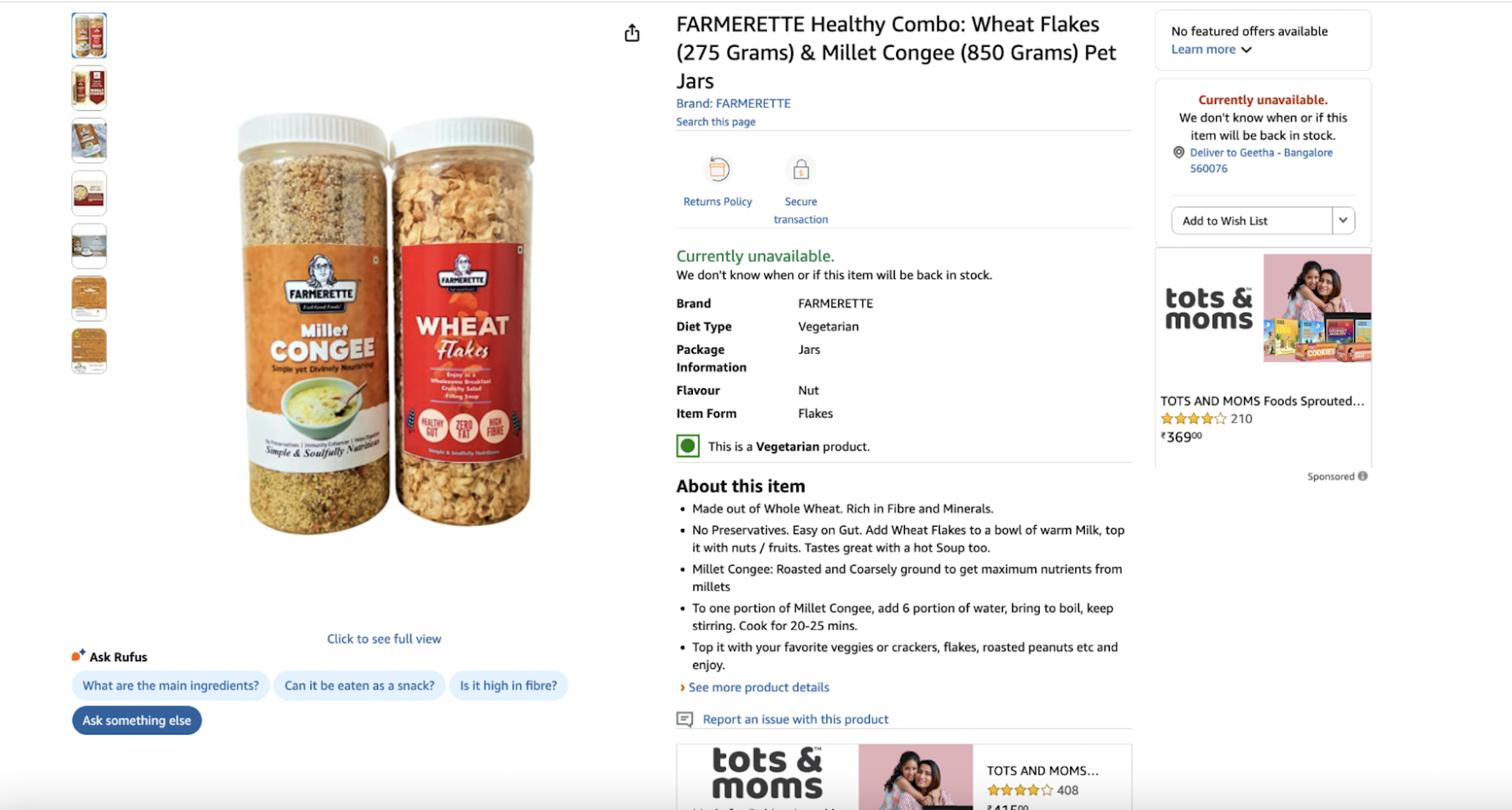
Farmett Health Foods Product Page
Summary How to capture the dual market structure
India's burgeoning digital marketplace presents many opportunities as well as challenges for consumers and businesses. Online retailing is very broad, with a wide variety of products and sales techniques, and marketplaces and e-commerce are pillars of market growth, each with different structures. The coexistence of both has created a dynamic and inclusive shopping environment that is unique to India and supports a wide range of players, from start-ups to well-established companies.
To effectively capitalize on this market, it is essential to understand the differences in how it works and to accommodate regional preferences, cultural factors, and payment methods such as CODs. As the Sundari Raju case shows, using digital marketing and unique online deployments is an effective strategy to build trust, increase sales, and grow the brand.
The Indian market has a "dual structure" with aspects more advanced than Japan (cashless society in urban areas) and aspects more conservative than Japan (cash dependence in rural areas). When Japanese companies enter the market, a realistic step-by-step strategy is to first test the market in a low-risk marketplace, adjust to the language, culture, and payment conditions of each region, and once mature, launch their own e-commerce nurture their brand.
*We will be happy to provide you with individual information on the following detailed case studies. Please contact us.
- Trends and entry steps by category for rapid sales growth during major sales and festival seasons
- Success/Failure Cases of Japanese and Foreign Brands and Risk Factors Specific to India
- Market analysis and local consumer purchasing behavior research for your product category
- Different purchasing channel usage and sales strategies in urban and rural areas (Tier 2-4 cities)
- Pricing and promotion strategies and the reality of local competing brands
- The specific impact of localization (language and cultural adaptation) strategies on consumer psychology
[*1]
https://www.cartoskill.com/interactive/linguistic-diversity-of-India/
Arunava Dey's CartoSkill, A Cartographer's Portfolio About Data Visualisation, Sunday August 17, 2025
Linguistic Diversity of India
[*2]
https://economictimes.indiatimes.com/tech/technology/amazon-to-launch-voice-shopping-in-hindi-soon/articleshow/86365792.cms?from= mdr
The Economic Times - Tech : Sep 20, 2021, 03:32:22 PM IST
Amazon to launch voice shopping in Hindi soon
[*3]
https://stories.flipkart.com/technology-smart-shopping-flipkart-app/
FlipKart Stories Krithika S / February 20, 2024
Access. Convenience. Safety: Leveraging technology to empower every Indian's dreams
[*4]
https://thesquirrels.in/news/online-buyers-vernacular-language-use-meesho-6808182
The Squirrels - Vinayak Chakravorty, 08 Aug 2024 18:26 IST
1 in 3 online buyers below 25, vernacular language use up 162%: Meesho
[*5]
https://www.pwc.in/assets/pdfs/how-india-shops-online-new.pdf
PricewaterhouseCoopers - © 2024 PwC. All rights reserved.
How India shops online: Consumer Preferences in the Metropolises and Tier 1-4 Cities
[*6]
https://www.spscommerce.com/blog/3pl-peak-season-strategies-2024/
SPS Commerce - Tracey Ortiz | Oct 11, 2024 | 3PLs, Data Management, Inventory Management, Order Fulfillment, Order Management, Retailer Requirements.
6 Essential Peak Season Strategies for 3PLs in 2024
Author Profile
Everything you need for cross-border e-commerce, supported by
global omnichannel